
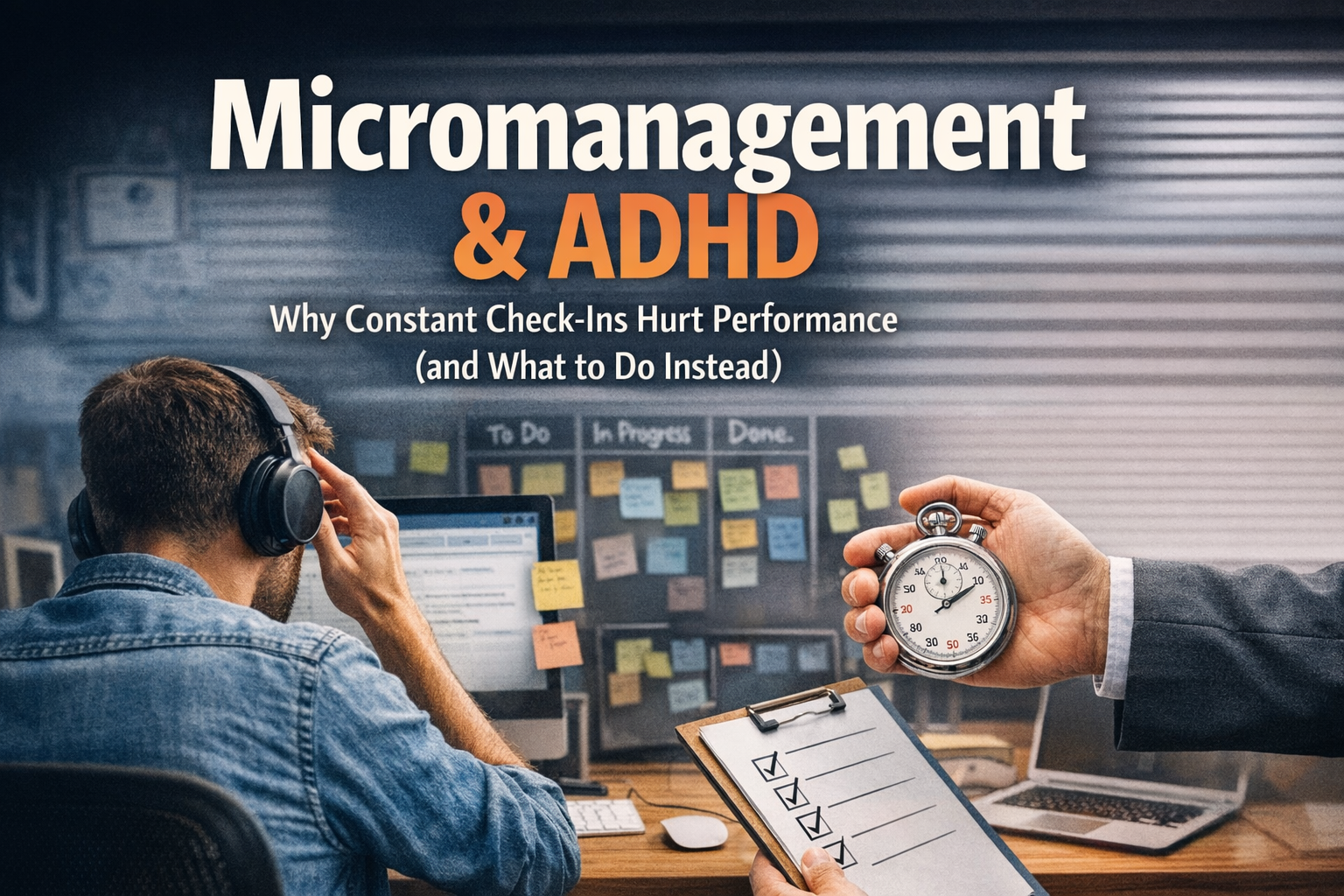

Micromanagement isn’t usually malicious. Most managers micromanage because they want quality, consistency, and fewer surprises.
But here’s the problem: when accountability becomes constant observation, ADHD performance often gets worse.
Not because the person doesn’t care. Because the job quietly turns into “prove you’re working” instead of “do the work.”
This article explains why micromanagement backfires for many ADHD employees and what to do instead if you want better outcomes with less chaos.
What Micromanagement Looks Like in Real Life
Micromanagement isn’t just “too many meetings.” It’s usually a pattern like: random “quick check-ins,” frequent status requests without clear deliverables, hovering over the process instead of measuring the outcome, last-minute priority changes that don’t get written down, and feedback on everything, all at once.
Even if the manager is well-intentioned, the message can land as: “I don’t trust you unless I’m watching.”
That changes how people work. Especially people with ADHD who rely on momentum and limited working memory.
Why Micromanagement Can Backfire for ADHD Performance
1) Micromanagement Breaks Momentum
Many people with ADHD don’t switch into focus instantly. They ramp up. Once they “catch the thread,” they can move fast and produce great work. But random interruptions reset that ramp.
What the manager sees: “They’re slow to start.” What’s happening: “They keep getting restarted before they get traction.”
If you want speed, you have to protect the ramp.
2) Micromanagement Adds a Working-Memory Tax
Working memory is your brain’s mental scratchpad. When it’s overloaded, performance drops. Constant check-ins can turn one job into four: doing the work, narrating the work, anticipating questions, and defending decisions in real time.
That extra load leaves less brainpower for execution.
3) Micromanagement Triggers Protection Mode
Even polite hovering can feel like real-time evaluation. That can trigger avoidance, procrastination, over-explaining, perfectionism, and shutdown.
Then the manager thinks: “See? They need more oversight.” And the loop gets tighter.
The Better Alternative: Structured Trust
Structured trust means: clear expectations + predictable support + ownership of execution. Not hands-off. Not “whatever you want.” Not guessing.
It’s clarity + ownership + scheduled visibility. The goal: get the visibility you need without interrupting the work.
How to Manage Employees with ADHD Without Micromanaging
1) Define the Outcome
Vague tasks create anxiety and invite micromanagement. Instead of “work on the project,” define: deliverable (what will exist when it’s done?), criteria (what makes it good enough?), deadline (when is it due?), and constraints (what rules matter?). When the outcome is clear, you don’t need constant check-ins.
2) Set Predictable Checkpoints
If you want updates, schedule them. This reduces interruptions and improves output. Options: daily 10-minute check-in, end-of-day 3-bullet update, or two checkpoints per week. Predictability creates safety. Safety creates execution.
3) Let the Person Own the Process
If you define the finish line, let them choose the route. Ownership improves follow-through. Surveillance reduces it. A simple rule: you own the outcome, they own the process, you coach the gap.
4) Write Decisions Down
Many ADHD work problems are actually “nothing got written down” problems. After a meeting, send: what we decided, who owns what, by when, and next checkpoint. This reduces repeated questions, rework, and surprise pivots.
5) Coach One Improvement at a Time
If quality is the concern, coach it. But don’t coach everything at once. One clear improvement is actionable. Ten becomes overwhelm.
6) Protect Uninterrupted Execution Blocks
Deep work doesn’t happen by asking for it. It happens by protecting it. Even 60–90 minutes can change output dramatically.
The Core Question
Managers: it’s not about less visibility. It’s about better visibility that doesn’t interrupt the work.
Are you optimizing for compliance… or outcomes?